






Diseases & Conditions
Tenosynovial Giant Cell Tumor (TGCT)
This article was previously titled and focused on pigmented villonodular synovitis (PVNS). Since the World Health Organization now classifies PVNS as a type of tenosynovial giant cell tumor, this article now refers to PVNS as giant cell tumor (TGCT). The article has also been expanded to include giant cell tumor of tendon sheath.
Tenosynovial giant cell tumor (TGCT) is a tumor that grows inside the thin layer of tissue that lines the joints and tendons (the synovium), causing the synovium to thicken and overgrow.
The tumor is not cancer and does not spread (metastasize) to other areas of the body. However, it is a locally aggressive progressive disease. What does that mean?
- When it involves the lining of joints, TGCT can damage the cartilage and area around the joint, leading to pain, swelling, and arthritis.
- When it involves the tissue around tendons, TGCT can lead to wearing down of the tendon and surrounding structures.
How Does Tenosynovial Giant Cell Tumor Affect Joints?
In a healthy joint, the synovium produces a small amount of fluid that lubricates the cartilage and aids in movement. In TGCT, the synovium is filled with a fragile, vascular tumor that bleeds easily. In addition to the tumor destroying cartilage and bone, bleeding from the tumor can lead to inflammation in and around the joint, causing swelling and making movement very painful.
TGCT typically involves only one site.
- In 80% of patients who have TGCT within a joint, the knee is involved
- However, it can also affect the hip, ankle, shoulder, and elbow.
- When TGCT affects tendons, this usually occurs along the wrist, hand, and fingers.
This condition can affect people of all ages, but it occurs most often in young adults from 20 to 50 years of age.
There are two forms of TGCT — localized and diffuse.
Localized TGCT
When the tumor occurs in just one area inside of the joint or around a tendon, it is called localized TGCT. This type usually responds well to treatment.
Diffuse TGCT
When the condition is more widespread and involves an entire joint or spreads along the length of tendons, it is called diffuse TGCT. This form tends to be more aggressive and is more difficult to treat.
Cause of Tenosynovial Giant Cell Tumor
The cause of TGCT is not known. Genetic changes associated with TGCT have been identified, but the evidence for a genetic cause is not clear at this time.
In some patients with TGCT, a small number of cells in the lining of the affected joint have a defect that makes them produce a protein called colony-stimulating factor 1 receptor (CSF-1R). Research has shown that this protein is involved in TGCT.
Symptoms of Tenosynovial Giant Cell Tumor
Localized TGCT:
- The main symptoms are pain and swelling in the affected joint, due in part to chronic inflammation that the tumor can cause. The swelling can be substantial.
- Other symptoms may include locking, catching, and instability in the joint, either due to the tumor or the arthritis that the tumor can cause.
Diffuse TGCT:
- There is often a gradual onset of symptoms including joint pain, swelling, and stiffness.
- Sometimes, patients may experience hemarthrosis, a condition in which blood collects in the joint space. This can occur with little or even no trauma to the affected joint.
In both localized and diffuse TGCT, you may be able to feel a mass, and symptoms may come and go over time.
Diagnosing Tenosynovial Giant Cell Tumor
Your doctor will perform a physical examination and use imaging and other tests to diagnose TGCT.
Tests
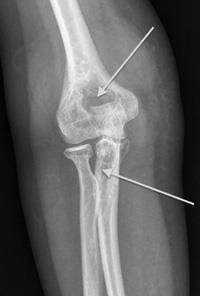
X-rays. X-rays provide clear pictures of bone. If TGCT has not damaged or caused changes in your bone, it may not appear in an X-ray. However, X-ray images may help your doctor rule out other causes of your pain.
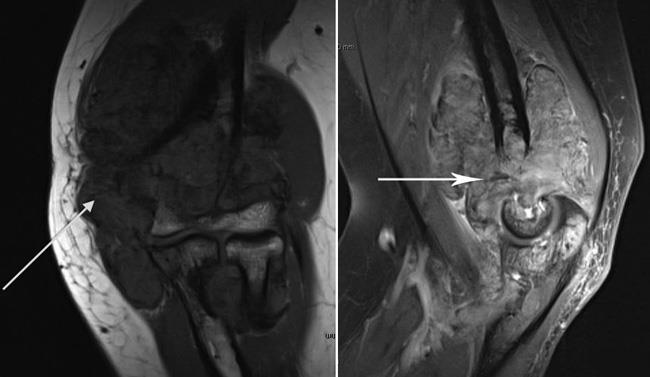
Magnetic resonance imaging (MRI) scan. An MRI provides clear images of the body's soft tissues and can be helpful in diagnosing TGCT.
- In localized TGCT, an MRI will show a nodular mass.
- In diffuse TGCT, an MRI will show extensive thickening of the joint lining throughout most of the joint or an extensive mass around tendons. For tumors inside of joints, there will possibly be bone changes and cartilage damage.
MRI can also help to identify blood within the tumor or joint, helping to make the diagnosis.
Joint aspiration. In this procedure, fluid is removed from the joint with a syringe and analyzed. In many cases of TGCT, the joint fluid is bloody.
The diagnosis of TGCT can usually be made by your doctor based on your symptoms and what is seen on the MRI. In some cases, however, a biopsy may be needed to help confirm the diagnosis.
Treatment for Tenosynovial Giant Cell Tumor
Because TGCT destroys healthy tendons, cartilage, and bone and can grow to a large size, treatment typically involves surgery to remove the tumor and the damaged portions of the joint lining.
Localized TGCT Outside of a Joint
When localized TGCT involves a tendon, your surgeon will perform a procedure to remove the tumor. If the tumor has also damaged the tendon, your surgeon may repair or reconstruct it during the procedure to remove the tumor. Your doctor will discuss the various surgical options with you.
TGCT Inside a Joint
Surgical Procedures
Arthroscopy. In many cases of both localized and diffuse TGCT, the tumor and damaged joint lining are removed arthroscopically.
During arthroscopy the surgeon makes a few small incisions around the joint and inserts a small camera called an arthroscope. The camera shows pictures on a video monitor, and the surgeon uses these images to guide small surgical instruments to remove the tumor and the damaged synovium (joint lining tissue).
Open surgery. Diffuse TGCT that affects both the front and back of the knee requires removal of the entire joint lining to reduce the chances of the tumor returning. In many cases, this is best achieved with traditional "open" surgery. Larger incisions on both the front and back of the knee:
- Give the surgeon full access to the joint
- Enable the surgeon to safely and effectively remove both the mass and the joint lining
Combined arthroscopic and open surgery. When most of the mass is in the back of the knee, the surgeon may use a combined surgical approach.
- The surgeon uses open surgery to remove both the mass and the joint lining in the back of the knee.
- The surgeon uses arthroscopy to remove the joint lining in the front of the knee.
This combined method decreases the scale of the surgery, allowing for an easier recovery.
Total joint replacement. In its end stages, widespread TGCT within joints can cause extensive destruction. Once the joint has become significantly damaged, sometimes the best option to improve pain and function may be a total joint replacement.
Total joint replacement is a procedure in which parts of a damaged joint are removed and replaced with metal and plastic parts. However, in some cases, the tumor may return even after the joint has been replaced.
Radiation Therapy
Radiation therapy can shrink tumors and is sometimes used to treat widespread diffuse TGCT. It is usually only for patients in whom standard surgery has not been successful and the tumor has returned. Radiation therapy may be used after repeat surgery to lower the risk of the tumor coming back.
Radiation therapy is given via an external beam that is directed from outside the skin to the inside of the affected joint. While often successful, this method can cause complications, including scarring and stiffness in and around the joint.
Drug Therapy
There are currently several medications being studied for the treatment of TGCT. These medications specifically target the CSF-1R protein produced by cells in the joint lining and have been shown to be effective in some patients. Like all medications, however, there are risks in using these drugs.
Your doctor will talk to you about whether you are a good candidate for drug therapy.
Recovery After Surgery for TGCT
After surgery, physical therapy will be very important in helping you return to your daily activities. Specific exercises will help you regain strength and range of motion in the affected joint.
- Recovery from arthroscopic surgery usually requires a short course of physical therapy, after which you may return to normal activity.
- Open surgery is more extensive, so there is an increased risk of post-operative stiffness. A more involved and longer physical therapy program is often required for patients recovering from open surgery to treat diffuse TGCT. In this case, the return to all usual activities will take longer — possibly several months.
Localized TGCT rarely recurs (returns) after surgery. The recurrence rate for diffuse TGCT is usually around 10% but can be as high as 30%. Patients with diffuse TGCT therefore require follow-up with their doctor for several years after surgery. During these visits, your doctor may order tests such as an MRI to check for recurrence of TGCT.
Contributed and/or Updated by
Peer-Reviewed by
AAOS does not endorse any treatments, procedures, products, or physicians referenced herein. This information is provided as an educational service and is not intended to serve as medical advice. Anyone seeking specific orthopaedic advice or assistance should consult his or her orthopaedic surgeon, or locate one in your area through the AAOS Find an Orthopaedist program on this website.